Showing posts with label LED video lights. Show all posts

Sunday, March 2, 2014

**NEW** Fiilex LED lights At Video Gear


We have a new LED light kit from Fiilex that just arrived in the shop.  Actually we now have both the 3-head and 4-head kits, but only the 3-head kit was available when I was in the shop taking pictures so that's the one I'm going to discuss here.  This kit is small, lightweight, and portable; lending itself to small corporate shoots and field portable documentary setups.

The 3-head kit comes with three P360 90-watt LED fixtures with color temperature variable from 3000K to 5600K.  The manufacturer claims that the light has light quality better than 92 CRI at all color temperatures in it's range thanks to its special multi-LED bulb.  The light level can be lowered down to 10% minimum.  The fixture uses an external brick power supply that can range from 12-28Vdc, which is both good and bad.  Bad in the sense that you have to wrangle an external power brick/set tripping source without a mid-cord power switch...which we all know is inconvenient for tall stands.  Good in the sense that you can, with the correct power adapter, plug in any broadcast battery and have long lasting portable power without any need for a power socket.  Anyone who does documentary or corporate shoots knows that there isn't always time to scout for power sockets, so it's good to have your own power available when you need it.


The rental kit comes with a well stocked number of light modifier accessories including a set of three dome diffusers, three barn doors, and a set of Fresnel lenses.  The diffuser and lens attach via a set of two magnets and simply snap into place - easy and quick.  Note that the diffusers and lenses are normally sold separately, but we want you to be fully stocked when going into the field. 


The kit also comes with a single speed ring and a snap on 15-inch soft box for the normal key light softening on corporate interviews.


Below are three pictures showing a typical light pattern of each of the bulb configurations.  First, the bare bulb, followed by the dome diffuser, and finally the Fresnel lens.  I forgot my light meter at home, so I grabbed an approximate 18% Lastolite chart from sales and a dark corner of the office to test the light's power output.  With a standard distance of 10 feet I found that I was getting an approximate exposure of f/2.8, ISO 800, 1/50th.  For those of you who read our previous blog about foot-candles you would be able to calculate in your head that this gives us approximately 12.5 foot-candles.  On the Fiilex web site they claim 15 foot-candles at 3000K and 17 foot-candles at 5600K and 10 feet. 

The second picture shows the dome diffuser.  The diffuser essentially steals one so I ended up at an approximate exposure of f/2.0.  This is approximately 6.3 foot-candles. 

The final picture shows the Fresnel lens.  This lens adds one stop because I was back up to approximately f/4.0, giving us about 25 foot-candles.


Last, but not least, here's a picture of the full kit laid out on our shop floor.  Note that the kit comes with lightweight stands and a Pelican-type roller case.  Everything fits into the size of a small carry-on suitcase.


If you're interested in renting or purchasing a kit, please call the shop.  As I mentioned before, we also have the 411 4-head kit available in case you want an additional light.  However, the 4-head kit only comes with two P360 fixtures and two smaller P180 fixtures.

Saturday, April 13, 2013

NAB Show 2013 Part 1: The Lights

Earlier this week Martin and I saddled up and headed northward into the desert for the annual National Association of Broadcasters (NAB) show in Las Vegas.  The second picture below is proof, just in case Martin needs to justify this as a business expense with his accountant.  Note to IRS, that's him in the blue shirt.  Ah yes, the casinos, the show girls, the taxis, the general disdain for wholesome living, and the lights... and that's where we are going to start this journey, with the lights.


First up is the default industry equipment supplier, Arri.  Although they did have some larger tungsten fixtures on display (but not on, since that would blow a circuit), the emphasis was clearly on their new line of "L" series LED Fresnels.  In the newest incarnation they made the fixture 1.5" shorter from front to back and added a fan, just like the Litepanels Sola/Inca fixtures.  Being a high end light, they allow control of both color temperature+shift and RGB.  This year they are also offering the L-series lights in black for studio installations because of customer requests.  Last time I checked the price was in the "if you have to ask..." category, but it's a well designed and built tool for sure.  The light takes standard barn doors.  Gels and scrims obviously aren't required anymore.


Next up is a innovative company called Hive.  Last year at NAB Zacuto was showing off a small plasma panel for video lighting.  This year Hive has taken that concept to a whole new level.  These lights put out daylight color temperature light with better spectral response than HMI.  In fact, Hive proudly publishes their spectral response and compares it with daylight.  With all the bashing of "daylight" LED lights over spectral response and color rendition, this is an excellent step toward gaining credibility.  Like an HMI, the light has a long strike time about 10 seconds from full off to full on - still much shorter than HMI.  The ballast is built into the lighting fixture, so you don't need to carry around a long umbilical cord attached to an external ballast, as is the case for HMI.  These lights consume about half the power of the equivalent light output HMI and operate completely flicker free, unlike tungsten, HMI, and most LED lights.  So fire up that Phantom camera!

The lights are dim-able, however there's one great bit gotcha.  As they dim the lights severely increase in color temperature.  In fact, at 50% output the color temperature goes up to 12000K - essentially moonlight.  So if you need a fixture for sunlight and moonlight, it's a two for one.

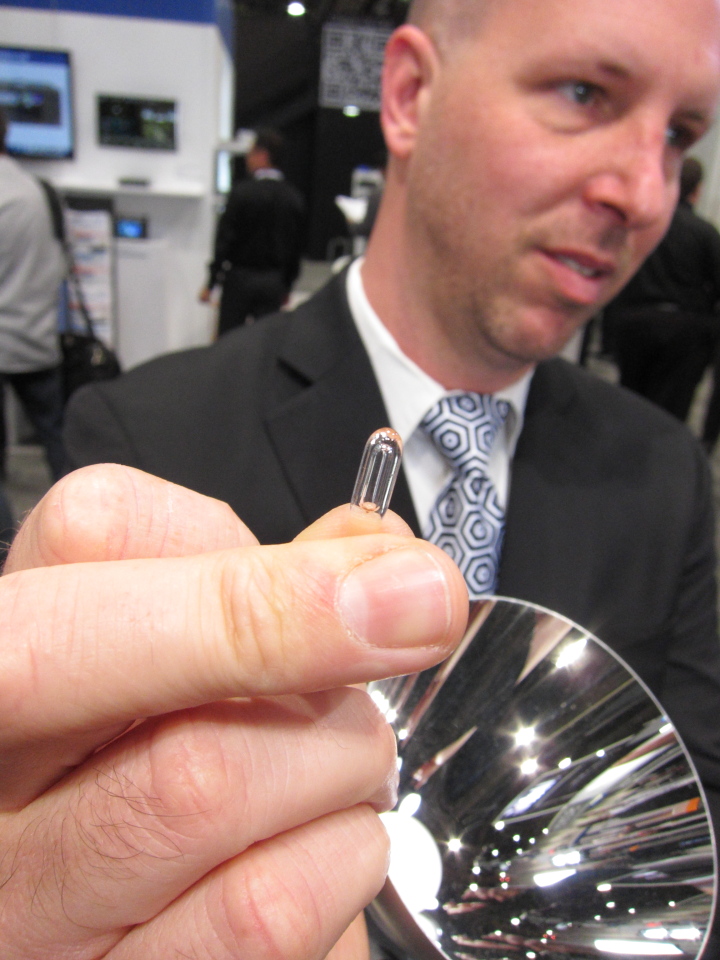
The third picture below shows the actual bulb.  Yes, that's it.  The bulb life is about 10,000 hours with no color change or output variation.  Total bulb life is about 30,000 hours.  The bulbs normally come in a large heat sink assembly and when the bulb dies, the whole assembly gets replaced by a service technician.


BrighShot is another small innovative company making RGB LED lights.  These fixtures come with a handheld controller that allows you to program the lights for various flashes.  For instance, these lights are used on most of the police dramas on television today.  Anytime you see patrol car lights on camera, but not the actual car, it's probably this light generating the gag.  The company owner showed us demos of flashing lights from an ambulance, police car (LA, NY, Chicago...yes, they are different), fire truck, lightning, and fire/flickering candle light.  The most annoying one was the flashing strobe (AUGH! MAKE IT STOP!).  Like the Arri light, dialing in a particular RGB color was easy with the controller in hand.


Ikan was showing off their wide array of LED lights.  Like Arri, they offer a number of lights with digitally controlled color temperature and dimming.  Unlike most vendors, they offer an LED strip light, as shown in the third photo below. This is perfect when you need to emulate a fluorescent fixture or you want an awesome back rim light.  Strip lights are used in fashion and portrait photography all the time, so it's good to know that someone is finally offering a solution for video.  As you might notice in the photos, the prices are well within the range of most budgets.  The representative explained that they have a no hassle warranty policy, which is good news to us.


Another small innovative company is Nila.  Currently they are best known for their "Boxer" series of LED lights.  The latest model has controls similar to the Ikan models.  One of their new innovations is the holographic lens, as shown in the third picture.  It's easy to mistake the cover as a typical diffuser, but this cover is actually a lens that controls the spot/flood beam width.  Just like the lens set that comes with a typical HMI Fresnel, you can exchange the holographic lenses in the field for various beam widths.

Also new this year is the idea of a "remote phosphor."  White LEDs are actually a very blue, ultraviolet emitting LED that excites a phosphor coating.  If you want a "daylight" LED you use a phosphor that emits less red/orange when excited by blue/UV light.  When you want a "tungsten" LED you use a phosphor that emits a lot of red/orange.  The idea here is that they move the phosphor coating normally on the LED itself to the yellow panel you see the representative installing.  Since this panel is user interchangeable, you can create whatever color temperature you want by installing a different "remote phosphor." 

Because the LEDs output very bright ultraviolet light they can damage your eyes, so the fixture has an automatic shut off switch that won't allow the LEDs to turn on while the remote phosphor panel isn't installed.  It gives new meaning to the old phrase, "don't look into the light!"


Brothers, Brothers, and Sons has a unique product in the sense that they have replaced the backing on a source four with an LED (product name: "Force V") and claim equivalent output to a 575W tungsten fixture at much lower power.  The Force-V light is flicker free (yeah!  over crank time!) and you can change the bulb from 3200K to 5600K in about two minutes in the field.  The optics are standard source four optics, but BB&S is working on their own.  So all source four cucalorus patterns should be compatible.  The rep showed me a demo and sure enough, nice even light pattern on the far wall.  Surely this will make a great replacement for the hand burning tungsten models.  You can see the rep placing his hands on the fixture when it's been on for a while.

BB&S also offers "LEDonardo" PAR cans as well as a remote phosphor "Area 48" fixture nearly identical to Nila.


Martin and I talked after the first day of walking through the show floor.  The problem with all these new lighting fixtures and technology is mainly a matter of gaining a solid reputation in the market.  People call up the shop and specifically ask for HMI lights, when the Plasma or LED equivalents might do just as well, if not better...AND with fewer hassles as far as power outlets and set safety are concerned.  We really want to get some of these fixtures into the shop and see how they perform in the real world, so hopefully you'll be reading about the reality of plasma and remote phosphor this summer.

Technology can be confusing, so please do call us if you have questions.  We're here to make sure you have a successful production and you buy/rent the right technology for your specific needs. 

Saturday, January 12, 2013

Comparing LED video lights

I went into the shop today to evaluate some of Video Gear's new LED lights and see how these compare to the industry standard HMI.  In the list were three lights from Litepanels, two lights from Film Gear, and one from newcomer Ushio.


There were really two parts to this evaluation:  First is total light power, second is color rendering.  In order to evaluate light power I set the light 10 feet from the test chart and measured exposure using my Sekonic light meter at 1/50th, ISO 100 - just because it seemed reasonable.  If the light beam spread was adjustable I measured in both spot and flood mode to see the range of exposure I could expect from the light.

For color rendering I set a Macbeth Color Checker 10 feet directly in front of the light with my camera set to a white balance of 5500k.  Each of the lights was theoretically a 5500k source according to the manufacturers, so this seemed like a way to at least take relative color measurements.  I obviously don't have a colorimeter that can measure the exact correlated color temperature (CCT).  The reason I say CCT is that LED's have a discontinuous spectrum that severely lacks cyan so you don't expect an LED light to render color as well as a tungsten nor HMI light.

1.  Litepanels Sola 6.  This is an LED based Fresnel with a built in lens that goes from spot to flood.  The power supply is housed just under the light (where you see the "Lite Panels" logo in the picture).  The light is dimmable and does not produce flicker nor audible noise except for a whisper quiet cooling fan.  No gloves are required since the light fixture only produces a small amount of heat.  In my measurements I found at the conditions listed above the light was able to get an exposure of f/4.0 to f/1.4 (spot to flood).  Not enormous amounts of light, but more than sufficient for the new line of native ISO 800 cameras.


2.  Litepanels Sola 4.  This little brother to the Sola 6 is equivalent in feature set, but is significantly smaller and obviously has less light output.  I was able to get exposures of f/2.8 to f/0.7(.8).  Again, this is about a two stop difference, which tells me that the two models probably share a similar design.


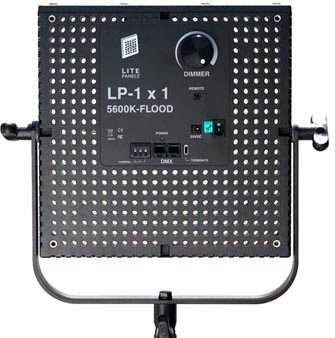
3.  Litepanels 1x1.  This is the industry workhorse when it comes to LED lights.  However, with this light you get a softer spacelight with no focus adjustment (at least on the model I used).  Since the dimmer goes down to zero output I was only able to evaluate the light at full output.  My exposure on this light was f/1.0(.6), a little more than one stop more than the Sola 4 in flood mode, but 1.5 stops less than the Sola 4 in spot mode.  In my opinion that's why the Sola's are worth the money - versatility.  You have to use an crate over this light to turn it into a spot and that only loses output.


4.  Ushio Pro Panel 1x2.  Ushio is the new kid on the block.  This panel features the ability to not only dim, but to set the color temperature from 2700k-6500k via an attachable control module.  For my tests I set the color temperature to 5500k.  Since this light only has a flood mode I found the maximum exposure I could get was f/1.0(.8) - essentially the same as the Litepanels 1x1.  Although the light fixture is double the size and obviously double the softness given the large diffuser. 


5.  Film Gear LED Flo (2ft x 4 bank).  This is a unique light that emulates the Kinoflo lights, but uses tubes of LEDs.  You can easily swap out the daylight tubes for tungsten balanced tubes.  The setup I was using came with a dimmer that allowed me to switch on the lights in two banks.  You can assign the banks however you wish since the connections to the LED tubes are arbitrary and user assignable.  My full output exposure reading on this light was f/1.0(0.3).  That's 1/3rd stop below the 1x1 and a half stop below the Ushio panel.


6.  Film Gear Daylight Fresnel HMI 575W.  I measured this light mainly as a reference since HMI's are industry standard.  What the photo doesn't show is that the light comes with a set of flags and a set of 5 or 6 (I don't remember) glass lenses that are put over the front of the light.  This light gets HOT!.  Not tungsten-immediately burn your fingers off hot, but still HOT!  Gloves are still recommended.  The fact that it doesn't have a built in Fresnel lens is less handy, but it does allow for focus adjustment of the PAR via a knob in the back.  Because this light has a number of external glass lenses I felt is was necessary to measure the output with more than one lens and also at spot and flood focus.  With the 10-degree lens the output measured f/11(.5) to f/2.8(.5).  With the 50-degree flood lens the output ranged from f/5.6(.5) to f4.0(1).  With the frosted diffuser the output was f/4.0(.7) to f/2.8(.7).  That's A LOT more output than any of the LED lights.  In fact, I took the glass lens out and measured the raw output...f/22(.2)!  Now that's a real light source.

Next, let's look at color rendering.


First, we'll start off with white balance.  Keep in mind that I was using a standard setting of 5500k on my camera.  The HMI light came out pretty much neutral at that setting, however we are looking at the relative color rendering since cameras can be custom white balanced.  With that said, it's also convenient to have a light that can mix with daylight and not cause a color shift.

Let's start with the neutral patches.  HMI has a slightly blue shift compared with absolute neutral.  The Sola 6 is lacking green, creating a magenta shift.  The Sola 4 has a much lower lack of green, so its magenta shift is fairly minor.  The Litepanels 1x1 and Ushio Pro Panel both have a large shift toward red.    The Film Gear LED Flo has a very, very minor shift toward red.  So the Sola 4 and Film Gear LED Flo seem to have the best neutrality of the bunch.  However, this neutrality is all relative.  I was surprised to see a difference between the Sola 6 and Sola 4.  It seems like they would be essentially the same technology.


Next, we'll look at the top line of the chart *after* a custom white balance on the neutral patches.  The top line of the chart is arguably the most important because if a light can't render skin tones properly then it's nearly unusable.  After the custom white balance the color rendering matches reasonably well with minor shifts.


Then finally we'll look at lines 2 and 3 of the Macbeth chart.  I see some slight differences on line 2 in the way orange is rendered.  Green seems to vary a bit as well.  Nothing hugely alarming here, but the differences do exist.

On line 3 I see some slight differences in the primary and secondary colors.  I expected to see some darkening in cyan since white LEDs lack cyan in their output spectrum, but so do the color filters on CMOS sensors.


If you're looking for a winner here, well there isn't one exactly.  The lights all work well and can produce nice results given the correct DP.  There are differences between lights, but the only colors that can easily be identified as wrong are skin tones.  Those seemed to look OK with a custom white balance.  Now if you're going to mix and match lights, this is an entirely different story.  The neutral patches above somewhat reveal which lights you should and shouldn't mix and not drive your color grading person nuts.

As always, if you have questions please call the shop.  We're here to help.