Sunday, April 21, 2013

NAB Show 2013 Part 2: The Reason to Go...Camera Porn


Even though this blog is primarily aimed at video professionals and a business that serves those professionals, it's almost an industry accepted term to talk about "camera porn."  There are always those pieces of gear that require you to perform at least one miracle that qualifies you for catholic saint-hood, a minimum of three Oscar wins, and knowing an inside man at Panavision before the manufacturer will let you touch it.  Being a male dominated industry, we lust after what we can't have.  Thus...camera porn.

As talked about in my previous post, Arri was there in full force.  The Alexa shown below is equipped with a 35mm anamorphic lens...drool!.  (Side note: Martin, when do we get a set of Zeiss anamorphics?)  The Ultra Prime and Master Prime lenses were behind glass cases.  After all, the fingerprint cleaning by an Arri tech in their class 1 clean room probably costs $1k/hr. 

The picture that I wish would have turned out better was the setup with the Arri geared tripod head.  After trying it out I want one!  Financially speaking it's not going to happen.  For now, I'm stuck with my "lowly" OConnor 1030D which I used to think was the best thing since sliced bread.  Now I have tripod head envy.  Note that this camera was also equipped with a 75mm anamorphic lens!  I was pulling focus on this camera while a couple b-boys were onstage dancing.  A couple guys behind me were commenting on how sharp the lens is.  I told them it was the focus puller. 


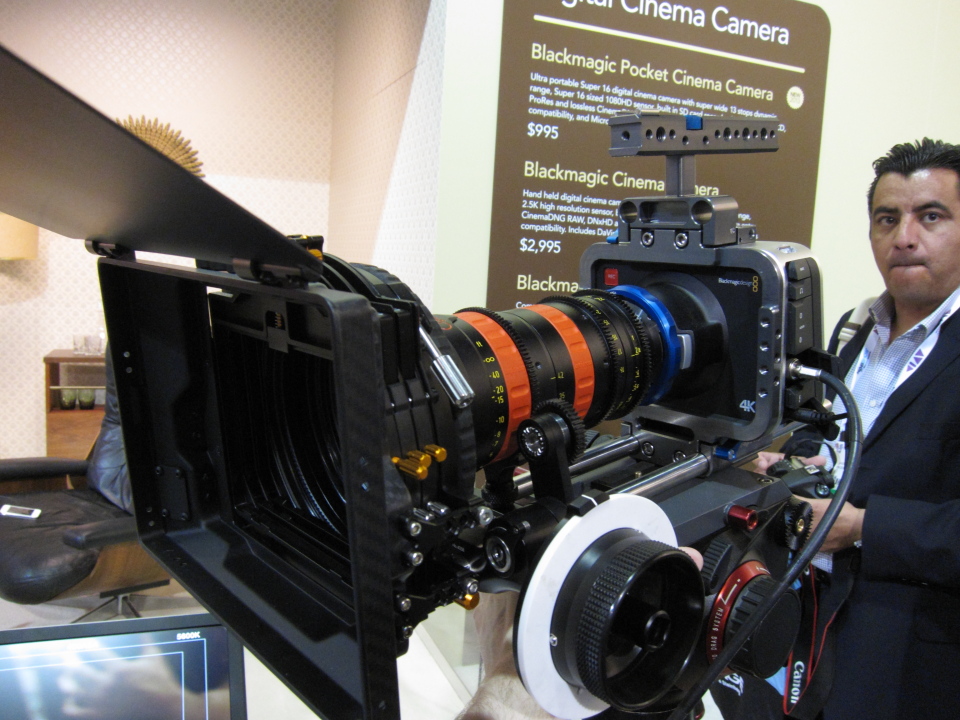
Blackmagic design stole the NAB show with their two announcements the night before the show opening.  The first shocker is a point and shoot size cinema camera with a super-16 sensor, 13 stops of dynamic range, and lossless Prores/CinemaDNG recording!  This is going to absolutely kill off DSLR video products.  In fact, it will likely take a hard bite into GoPro's Black Edition camera.  With a micro-4/3rd's lens mount you can adapt just about any lens to it.  My Zeiss ZF.2's will work perfectly.  The downside?...It still has rolling shutter.  I gave the camera a little whip-pan and the rolling shutter was about as bad as a DSLR.  Still, it's an awesome product for the price.  On my way home I saw a friend in the airport and he had already purchased one online!  The camera is *supposed* to be released in June.

The second shocker was a Production 4k camera.  This has the same odd form factor and lack of XLR audio inputs as the current BMCC, but it has a super-35 size sensor and GLOBAL SHUTTER!  the next step up to get 4k with global shutter is the Sony F55 at a body price of $26k!...and if you want raw it comes with the Blackmagic camera whereas the Sony requires another $7k bolt on box+battery+SSD.  If and when the camera gets released I'm strongly considering a purchase.  The ergonomics, connectivity, and controls aren't as nice as the Sony camera but at $4k who can argue?  Did I mention the global shutter?  Now the downside...Blackmagic said that the dynamic range will only be 11-12 stops and the target native ISO is 400.  So the Sony/Red solutions have the Blackmagic camera clearly beat in technical performance.


Convergent Design had their interesting new Odyssey 7 recorder/monitor solution.  The concept is that you rent codecs on a pay as you go basis.  So if you need Arri raw, you can rent it for a few days.  Need Prores HQ, rent it.  The rep said that they will also offer the option of purchasing the codecs.  At $1300 the Odyssey 7 makes a great OLED field monitor with true blacks.  My guess is that in a few years you'll be hard pressed to find an LCD field monitor from anyone but the Chinese knock-off folks.  The Odyssey 7 comes with a full set of scopes and for another $1k you get more 4k support including FS-700 4k raw.  Given the size of this panel, I would like to see them produce a 5" version as well so the monitor doesn't dominate the camera as is does in the photo with the Epic below.

The other interesting product I saw at their booth showed a collaboration with I/O Industries.  The IOI camera has a 2/3" sensor with global shutter and allows for a number of lens mount options including electronic control of Canon EF lenses.  Here, the camera is mostly shown with c-mount lenses.  The downside to this solution is the lack of built in battery and monitoring options, but the camera does output 1080p and 2k streams over SDI with over cranking, including raw.  Every solution has its positives and negatives, but I can clearly see this solution being used in action and motor sports...maybe even reality shows for POV shots.  Just think about the Act of Valor Navy Seal POV shots. 


This is a well defined picture of camera porn.  I wasn't even allowed to take a picture of the other half of the Leica glass case!  Martin...anamorphic lenses...just saying.


Panasonic didn't have any new cinema cameras to show, but they were showing the new P2 format, which is the SD Card form factor.  The difference between a standard SD Card and the P2 card is mainly guaranteed performance.  As anyone who has bought "the great deal" on SD Cards knows, card reliability and throughput varies wildly with cheap/generic cards.  Panasonic will also allow Class 10 SD Cards to be used in their new P2 cameras.  Since PCMCIA is pretty much dead this seems like a great upgrade path for Panasonic customers.


So...speaking of performance...I'm not sure which booth this picture was taken in, but someone was showing off the Phantom cameras including the new "affordable" (it's a relative term) Phantom Miro.  Definitely camera porn.  Las Vegas will probably be the only place I see these cameras.


Red has been building on the concept of a digital motions/stills camera for some time.  The mount in the first picture below allows you to swing the camera 90-degrees clockwise in case you want to record in portrait mode.

Red was also showing off their "global shutter".  This shutter solution is installed as an optional lens mount and is an LCD that they place in front of the sensor.  You lose 1 stop of light, but with the Dragon sensor coming in at a native sensitivity of 2000 ISO, who cares?  The demo consisted of a TV screen and a spinning fan.  Both behaved properly when the global shutter was turned on.  It can be electronically turned off via the control panel, but then you would clearly see the jello-cam return.

In classic Jim Jannard fashion, Red was building Dragon sensor cameras on the show floor in a portable clean room.  Anyone who has dealt with Red knows about Red's lack of credibility with regard to delivery schedule.  This move may shut the critics up for a bit...or people may ask, where's my camera?  I saw it being built at NAB!


Sony F5 and F55 cameras were EVERYWHERE at NAB.  Every rental house, catalog company, or large equipment supplier had an F55 in their booth.  The main way you can tell them apart is by the PL mount color.  The F55 PL mount is silver.  The F5 PL mount is black.  It was fairly clear that Sony's dual bombshell offerings are going to be very popular in production in the coming year.

We stopped by the Sony booth and talked with Jody Eldred, who had recently done a camera event at Video Gear.  He took the F55 out to Red Rocks and shot back lit skies against the rocks in raw.  The color grading guy at the Sony booth was able to recover both the sky and the rocks is Davinci Resolve from the raw footage!  There's no way either would survive with a DSLR or any 8-bit compressed codec.  The camera does a true 14 stops, just like the Alexa, but with global shutter, and at 1/3rd the cost!

The F55 includes 4k internal recording onto SXS Pro+ cards ($1k+), whereas the F5 only records 2k and HD internally.  The F55 can over crank to 240fps, whereas the F5 "only" goes up to 120fps.  So there is a clear differentiation in technical performance.  For documentaries the F5 seems good enough, but for action sports and commercials the F55 has an advantage.  Another technical advantage of the F55 is that it has the same wide DCI color gamut of the F65, mainly for cinema use.  The F5 is limited to rec.709 color gamut.

Sony also showed their FS-700 raw solution.  It's real, but it's not quite what I thought it would be.  The solution takes multiple parts:  A $3k cable break-out box, a $5k raw recorder, at least one SSD at $1k (everyone will want at least two), and a V-mount battery brick at $500-$1k.  So that little $8k camera turns into a $18-19k camera that doubles in size and probably triples in weight.  At a certain point it just makes more sense to get the F5 if you really need raw or just a high quality direct to edit codec.  I don't believe the FS-700 raw option firmware includes S-LOG2, so the F5 seems like a better option if you're trying to obtain high quality footage with a light weight camera setup.


Atomos showed their update to the Samurai product called the Samurai Blade, which is mostly an upgrade to a high resolution IPS panel version of the Samurai.  If you read my previous review of the Samurai the LCD panel was a weak point of their product so this is a welcome improvement.  The Samurai Blade also includes a full set of scopes, just like the Convergent Design product.  The supported codecs are still limited to Prores and DNxHD 10-bit 4:2:2, but those are very nice and easy to use codecs.


Part 3 comes next week when I'll wrap up the remaining stuff.

Saturday, April 13, 2013

NAB Show 2013 Part 1: The Lights

Earlier this week Martin and I saddled up and headed northward into the desert for the annual National Association of Broadcasters (NAB) show in Las Vegas.  The second picture below is proof, just in case Martin needs to justify this as a business expense with his accountant.  Note to IRS, that's him in the blue shirt.  Ah yes, the casinos, the show girls, the taxis, the general disdain for wholesome living, and the lights... and that's where we are going to start this journey, with the lights.


First up is the default industry equipment supplier, Arri.  Although they did have some larger tungsten fixtures on display (but not on, since that would blow a circuit), the emphasis was clearly on their new line of "L" series LED Fresnels.  In the newest incarnation they made the fixture 1.5" shorter from front to back and added a fan, just like the Litepanels Sola/Inca fixtures.  Being a high end light, they allow control of both color temperature+shift and RGB.  This year they are also offering the L-series lights in black for studio installations because of customer requests.  Last time I checked the price was in the "if you have to ask..." category, but it's a well designed and built tool for sure.  The light takes standard barn doors.  Gels and scrims obviously aren't required anymore.


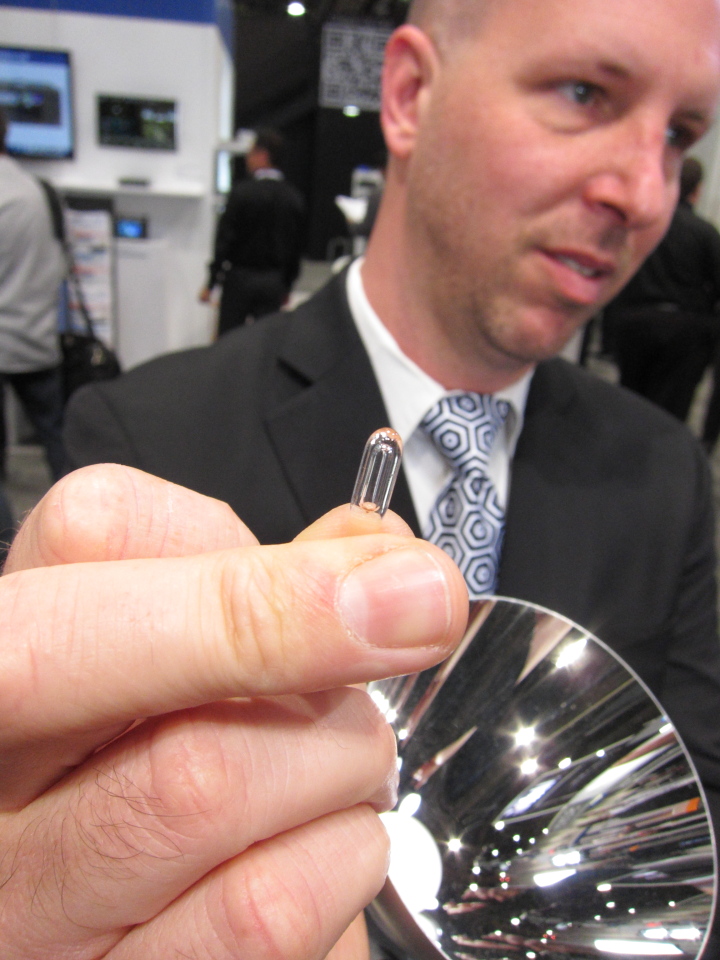
Next up is a innovative company called Hive.  Last year at NAB Zacuto was showing off a small plasma panel for video lighting.  This year Hive has taken that concept to a whole new level.  These lights put out daylight color temperature light with better spectral response than HMI.  In fact, Hive proudly publishes their spectral response and compares it with daylight.  With all the bashing of "daylight" LED lights over spectral response and color rendition, this is an excellent step toward gaining credibility.  Like an HMI, the light has a long strike time about 10 seconds from full off to full on - still much shorter than HMI.  The ballast is built into the lighting fixture, so you don't need to carry around a long umbilical cord attached to an external ballast, as is the case for HMI.  These lights consume about half the power of the equivalent light output HMI and operate completely flicker free, unlike tungsten, HMI, and most LED lights.  So fire up that Phantom camera!

The lights are dim-able, however there's one great bit gotcha.  As they dim the lights severely increase in color temperature.  In fact, at 50% output the color temperature goes up to 12000K - essentially moonlight.  So if you need a fixture for sunlight and moonlight, it's a two for one.

The third picture below shows the actual bulb.  Yes, that's it.  The bulb life is about 10,000 hours with no color change or output variation.  Total bulb life is about 30,000 hours.  The bulbs normally come in a large heat sink assembly and when the bulb dies, the whole assembly gets replaced by a service technician.


BrighShot is another small innovative company making RGB LED lights.  These fixtures come with a handheld controller that allows you to program the lights for various flashes.  For instance, these lights are used on most of the police dramas on television today.  Anytime you see patrol car lights on camera, but not the actual car, it's probably this light generating the gag.  The company owner showed us demos of flashing lights from an ambulance, police car (LA, NY, Chicago...yes, they are different), fire truck, lightning, and fire/flickering candle light.  The most annoying one was the flashing strobe (AUGH! MAKE IT STOP!).  Like the Arri light, dialing in a particular RGB color was easy with the controller in hand.


Ikan was showing off their wide array of LED lights.  Like Arri, they offer a number of lights with digitally controlled color temperature and dimming.  Unlike most vendors, they offer an LED strip light, as shown in the third photo below. This is perfect when you need to emulate a fluorescent fixture or you want an awesome back rim light.  Strip lights are used in fashion and portrait photography all the time, so it's good to know that someone is finally offering a solution for video.  As you might notice in the photos, the prices are well within the range of most budgets.  The representative explained that they have a no hassle warranty policy, which is good news to us.


Another small innovative company is Nila.  Currently they are best known for their "Boxer" series of LED lights.  The latest model has controls similar to the Ikan models.  One of their new innovations is the holographic lens, as shown in the third picture.  It's easy to mistake the cover as a typical diffuser, but this cover is actually a lens that controls the spot/flood beam width.  Just like the lens set that comes with a typical HMI Fresnel, you can exchange the holographic lenses in the field for various beam widths.

Also new this year is the idea of a "remote phosphor."  White LEDs are actually a very blue, ultraviolet emitting LED that excites a phosphor coating.  If you want a "daylight" LED you use a phosphor that emits less red/orange when excited by blue/UV light.  When you want a "tungsten" LED you use a phosphor that emits a lot of red/orange.  The idea here is that they move the phosphor coating normally on the LED itself to the yellow panel you see the representative installing.  Since this panel is user interchangeable, you can create whatever color temperature you want by installing a different "remote phosphor." 

Because the LEDs output very bright ultraviolet light they can damage your eyes, so the fixture has an automatic shut off switch that won't allow the LEDs to turn on while the remote phosphor panel isn't installed.  It gives new meaning to the old phrase, "don't look into the light!"


Brothers, Brothers, and Sons has a unique product in the sense that they have replaced the backing on a source four with an LED (product name: "Force V") and claim equivalent output to a 575W tungsten fixture at much lower power.  The Force-V light is flicker free (yeah!  over crank time!) and you can change the bulb from 3200K to 5600K in about two minutes in the field.  The optics are standard source four optics, but BB&S is working on their own.  So all source four cucalorus patterns should be compatible.  The rep showed me a demo and sure enough, nice even light pattern on the far wall.  Surely this will make a great replacement for the hand burning tungsten models.  You can see the rep placing his hands on the fixture when it's been on for a while.

BB&S also offers "LEDonardo" PAR cans as well as a remote phosphor "Area 48" fixture nearly identical to Nila.


Martin and I talked after the first day of walking through the show floor.  The problem with all these new lighting fixtures and technology is mainly a matter of gaining a solid reputation in the market.  People call up the shop and specifically ask for HMI lights, when the Plasma or LED equivalents might do just as well, if not better...AND with fewer hassles as far as power outlets and set safety are concerned.  We really want to get some of these fixtures into the shop and see how they perform in the real world, so hopefully you'll be reading about the reality of plasma and remote phosphor this summer.

Technology can be confusing, so please do call us if you have questions.  We're here to make sure you have a successful production and you buy/rent the right technology for your specific needs. 

Saturday, April 6, 2013

Review of the Atomos Samurai

As some blog readers may recall, a few weeks ago I received a call from Salvador saying they just got the Atomos Samurai into rental stock and they needed someone to run it through it's paces.  My friend Mike has the first generation Atomos Ninja, which came with the associated first generation "loose ends".  The Samurai, on the other hand, it really a second generation product since the Ninja-2 is also out now.  The Ninja is oriented toward HDMI output cameras and the Samurai is for SDI output cameras.  Both support high quality Prores and DNxHD codecs.  The Samurai has a slightly larger display. 

The Samurai came neatly packed as a kit and assembly seemed to go OK until I found out that the Samurai wouldn't power on!  Reading the manual surely would have helped (didn't have time in this case), but the bottom line is that you need to know to install battery #1 first.  Installing a battery in slot #2 didn't allow the unit to boot.  I would have guessed that the batteries would be auto-sensing, but that wasn't the case.  Powering down the unit requires you to press the "on" button for a few seconds similar to Red cameras and iPods.

The kit includes two batteries, two SSDs, an SSD reader, battery charger, and all the connection cables.  It's only missing one thing, and I'll get to that later.

In the pictures below you can see that the Samurai has connections for SDI in/out, time code in/out, and audio in/headphone out.  Audio comes in from the camera via SDI, so you don't need to connect any extra cables to get the footage to have audio from the camera.  There are 1/4"-20 screw threads for mounting the recorder unit to your camera via a standard cine-arm.

You can only install one SSD at a time, so when the SSD is full, it's full.  In practice, I found with both days of shooting I was averaging about 55 Gigabytes/day.  I didn't even fill up one 128GB SSD, much less get to the second one!  So for an average non-continuous event day I wouldn't worry too much about storage, personally speaking.

You can format the SSDs while they are installed in the Samurai, but I found it was non-obvious to do (which is probably a good thing) and didn't have time to run through the manual to find the answer!  So I formatted the SSD on my PC instead using the supplied SSD reader over USB. 


OK, so how did it really do?  Wow!  What a HUGE difference over the FS-700's built in AVCHD codec.  It's amazing what a good Prores HQ codec can do for a modern CMOS sensor, like the FS-700.  It took the detail from being on par with a DSLR solution to looking like a professional video camera.  Mind you, it's still not 10-bit, but you do get 4:2:2 chroma sampling and a ~100Mb/s codec.  On my monitor at home I could easily see detail when shown at full HD.  Except for some very minor white balance tweaks to the opening of the video embedded below and one luma curve adjustment midway through, I didn't really do any color correction or grading.  The footage didn't need it.  It looked beautiful straight out of the camera.  I even turned off sharpening (i.e. "detail") in the camera and didn't apply any sharpening in post...not needed.

Now I don't want to use the FS-700 without the Samurai.  Salvador is sneaky.  It was his secret plan to turn me into a Samurai addict!

Once booted, operating the Samurai is all via touchscreen.  When you go into Monitor mode you can start the recording from there.  Playback is just as simple.  When in the playback menu you select the clip you want to view and tap it.  It starts playing.  Operating is that simple.  I didn't need the user manual - as it should be.


Now comes the downsides, which are minor, however may be significant in some circumstances.  In the second picture above you can see the display in action at the Saturday night concert I filmed.  The first problem I noticed is that the monitor is not color accurate, at all.  In fact, it's quite far off from being accurate.  Don't trust it for white balance or as a preview monitor for lighting. 
 
The second problem is that the monitor is quite dim when outdoors.  The third photo above has the monitor on in full daylight.  I have to say that the photo actually shows the image about the same as your eye would see it in the field.  Click on the picture and you'll see that the image IS actually of the actor, but with the reflection of me taking a photo dominating the display.  It was very difficult to use the Samurai outdoors because of this.  It would be great if Atomos included some type of EVF loop or extended hood so the monitor was usable outdoors.  That's the only item the kit is missing.
 
The good part about the the dim display is that the Samurai has great battery life.  I was outdoors filming a narrative short all day Sunday and I only had to switch out the little battery once!
 
At the concert I did briefly try out the peaking to see how it compared with the FS-700's built in peaking.  This is just my opinion, but I found that the FS-700's built in peaking was a bit more sensitive and worked better for me.  That's not to say it's unusable or bad on the Samurai, just that *I* prefer the Sony peaking filter.  The Samurai also has false color, zebras, and blue only, if you want to use those instead of the camera's assisting tools.
 
Obviously any time you add a piece of gear to a camera it adds weight and complexity.  You can see in the photo above that the Samurai was easily suspended by my Noga cine-arm.  However, the cable routing was a bit of a bugger.  The Samurai uses a proprietary mini-BNC at its end of the SDI cable.  I was stuck with this length and no clear way to strap the cable down.  The cable was protected the old fashioned way, I watched out for it closely both days.
 
Overall, I believe the Samurai is a mature product that I would take into just about any shooting situation and feel comfortable with it's reliability and high quality recording capability.  Below is a short documentary produced about four hours after picking up the camera setup from Video Gear on Saturday night.  Some of the BTS photos are shown above.  Enjoy.


Oh, and if you have questions about renting the Samurai just call Salvador at the shop.  We're here to addict help you.

Saturday, March 30, 2013

Video Gear will be at Photo Video West on April 27-28, 2013


Video Gear will be at Photo Video West on April 27-28,2013. We are so excited to be exhibiting at our first trade show! We will be demonstrating Manfrotto Video tripods and RedRock camera rigs.  Come see us at Booth 106, the whole crew will be there. The expo will be at the Del Mar Fairgrounds in Del Mar, in north county San Diego. It will probably be easiest to enter off Jimmy Durante Blvd to get to the O'Brien Hall.  There will be some special offers on new equipment that we can't talk about here, so keep your eyes open. (hint, throw an old beater tripod in the car, it might be worth more than you think.)


Photo Video West will showcase cutting edge gear and educational seminars for photo and video shooters, both pros and newbies alike. This year’s featured presenters include world famous professionals such as Colin Smith of PhotoshopCAFE, Victor Ha of Cinevate, and Jay P. Morgan of The Slanted Lens. Whether you are an amateur interested in improving shooting skills or an advanced professional interested in networking with the top experts in the field, Photo Video West is not to be missed by those who share in the joy of being behind the lens.

We hope you can attend and check out new products from Manfrotto including the new fluid head tripod being announced at NAB on April 8th. If you need more information about the event, check out Photo Video West’s website at www.photovideowest.com or www.Video-Gear.com. To receive real-time updates on the event, subscribe to Photo Video West’s twitter channel @PhotoExpoWest and like Photo Video West’s Facebook page at www.facebook.com/PhotoVideoWest.

For discount admission (it's pretty affordable to begin with) go to:
http://preview.tinyurl.com/cno9f4x


Photo Video West Hours
April 27th 10:00am – 5:00pm
April 28th 10:00am – 4:00pm

Sunday, March 24, 2013

Special Seminar with Larry Groupé, Saturday March 30th

Video Gear, in conjunction with the San Diego Filmmakers, is hosting a special seminar with music composer Larry Groupé next Saturday.  I've seen Larry speak at the SDF meetings twice now and he is well worth the time and effort if you care about music in your film.  More than likely you have heard Larry's work in many Hollywood productions and just don't know it yet.


Copy from the SDF original advertisement
 
As a filmmaker, do you want to know how to best use music to pull your film together?
Or, as a composer, do you want to know how to work with a filmmaker to help make their project even better?

Learn from Larry Groupé, one of the most talented and versatile composers working today in the entertainment industry. With an impressive musical résumé in film and television as well as the concert stage, his achievements have received both critical praise and popular acclaim. Larry's latest film release is "Straw Dogs" for Sony Pictures. He has been nominated for an Emmy® three times and has won twice.  Here is a link to his IMDB listing.

Click on this link to register
http://tinyurl.com/bkum46a

This 3 1/2 hour seminar with Larry Groupe is $45 before 3/29.
$60 at the door.

This special seminar is in addition to the networking event on Mon. 3/25.
http://www.facebook.com/events/428482007236766/?ref=14

Music can be instrumental in pulling the entire movie together. Thematic ideas can bring focus to a number of different elements in the movie. The musical score can be one of the highlights and strong points of the entire film. The composer should be able to get a true sense of what the film is attempting visually and relate it to the score. Larry Groupé will discuss film making through the eyes of a composer who not only loves music, but is insanely in love with film.
We look forward to seeing you there on Saturday, March 30th at 9:30 AM