Showing posts with label ikan. Show all posts

Saturday, April 27, 2013

NAB Show 2013 part 3: A Little More Action Please...

I felt like I had to throw in a reference from the Elvis song "A Little Less Conversation" for the grand blow-out finale from my NAB reports.  I mean we've already had lights, cameras...and what comes next...ACTION!  Sorry, no showgirls or "thunder from down under" in this last installment, but I did find a cool looking Bolex at the Kessler booth.  Sadly for some, that's equivalent.


One of the largest product introductions at the show and maybe one of the largest bits of excitement in Hollywood this year is Freefly's MoVI.  It's a solid state gyro stabilized handheld camera rig.  As shown in the picture it's mostly made of carbon fiber composite, so the price isn't for the faint of heart.  ...and yes, you can operate it alone.  There are two modes: one with a second op on a joystick; the second where the stabilizer slowly adapts to where you are moving the camera - essentially smoothing out your handheld shaky-cam.

I saw Q from Revolution Cinema the next day and he was trying to get one for Shane Hurlbut.  Sounds like the folks from CSI and JJ Abrams are already starting to put it to work.  As soon as these rigs become prevalent around Hollywood the Steadicam is pretty much dead.  I also caught up with my friend Blair on Sunday and he said his Steadicam operator friends are all swearing up a blue streak (not in a good way) after seeing this rig in action.  What they need now is a way to comfortably get the camera up into shoulder mount position.  Trying to lift a 15lb weight above your head all day isn't going to be user friendly.  That would be like trying to operate a 15lb Steadicam all day without the vest.  Ouch!

Just like a Steadicam you're going to have to invest in a wireless follow focus and a wireless HD transmitter.  Freefly hasn't integrated those items just yet.  I saw a Bartech wireless follow focus ($10k!) attached to the demo unit.


I know the last report talked about camera porn...well, say hello to crane porn.  Yes, every super-jib-techno-extender-vendor on planet was there to show off their 30-50ft cranes.  It's awesome to see these precision machines fly a camera around like it's nothing.  I have to give a shout out to Sara in the Kessler booth (4th photo below).  She kept me from accidentally bonking Rodney Charters on the head while demo-ing the new Kessler Pocket Jib (shown in pic).  That would have been a very sad day indeed.  I don't need to be known as the guy who sent Rodney to the Las Vegas hospital with a concussion.

The fifth photo shows the new Kessler Cinedrive system attached to their motorized head.  Somehow it seems inadequate to match their computer controlled system with a low end DSLR, but they need something to demo it with.  For small camera computerized movement this system seems light years ahead of the other vendors.


Ikan was showing off their new wireless HD transmitter and receiver.  Oh, how I could have used one of these many times.  As you can see on the price tags it's not cheap, but so far no one has a cheap real time HD transmitter system.  The competitors are Teradeck and Boxx - both high end solutions.  It's intriguing from a technology standpoint.  Maybe we'll have to get one in the shop and see how well it works.(?)


Audio!  ...the forgotten and abused red-headed stepchild of video production.  I haven't forgotten you.  Audio was my first entry into film making and I don't like to compromise when it comes to audio quality.  Bad audio just says "I don't care about the quality of my work."  The Sennheiser booth was buried in a small hard to find corner of the showroom floor.  Despite the show organizer's best efforts I found it!  They were showing their new MKE 600 shotgun mic.

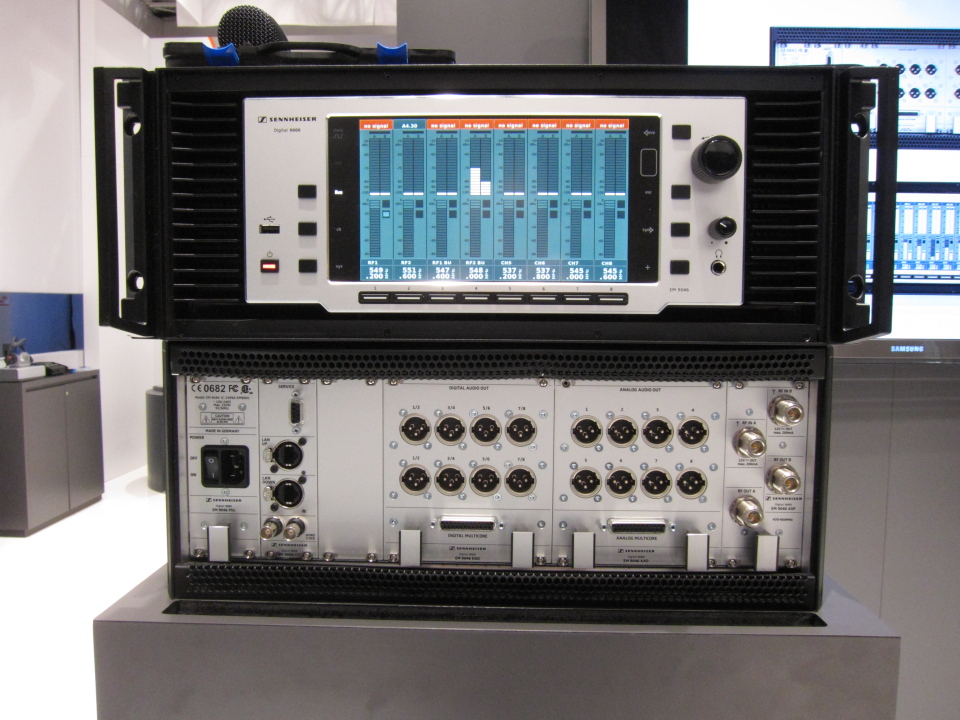
More importantly I found their new SK9000 wireless lav kit.  The new transmitter has a lithium ion battery pack that lasts 10-12 hours (their rep's claim).  So no more changing out AA batteries during a day long shoot.  ...and for the audio tech who feels that a simple receiver doesn't impress the boss, there's the 9000 series rack mount receiver.  The rep said this setup just went on the road with Harry Connick Jr. 


Last, but not least are our friends at Tenba.  I personally bought their made in the USA tripod bag and was looking for a lens/camera case.  That's Peter, their sales rep, over on the far left demonstrating a case.  Victor Ha was also working at the Tenba booth as part of the Mac Group.  Victor is holding a class at Video Gear in two weeks on DSLR video, so it was good to pre-meet him at the show.

The bag I like and intend to buy is the Roadie II Large.  It will fit my camera plus all my lenses, filters, and a few other goodies in one small carry-on size suitcase.  Video Gear sells Tenba, plus Kata and Cinebags.  Stop by the showroom if you'd like a demonstration.   


That's it for this year.  I know we have a lot to talk about internally at Video Gear.  There are many great up and coming products that deserve attention.  Our intention is to get many pieces of the gear mentioned in this three part NAB report and see what it does in the real world.  Video Gear rents what we sell and sells what we rent.  If you're interested in any particular item mentioned here just give Jeff a call at the shop.

Saturday, April 13, 2013

NAB Show 2013 Part 1: The Lights

Earlier this week Martin and I saddled up and headed northward into the desert for the annual National Association of Broadcasters (NAB) show in Las Vegas.  The second picture below is proof, just in case Martin needs to justify this as a business expense with his accountant.  Note to IRS, that's him in the blue shirt.  Ah yes, the casinos, the show girls, the taxis, the general disdain for wholesome living, and the lights... and that's where we are going to start this journey, with the lights.


First up is the default industry equipment supplier, Arri.  Although they did have some larger tungsten fixtures on display (but not on, since that would blow a circuit), the emphasis was clearly on their new line of "L" series LED Fresnels.  In the newest incarnation they made the fixture 1.5" shorter from front to back and added a fan, just like the Litepanels Sola/Inca fixtures.  Being a high end light, they allow control of both color temperature+shift and RGB.  This year they are also offering the L-series lights in black for studio installations because of customer requests.  Last time I checked the price was in the "if you have to ask..." category, but it's a well designed and built tool for sure.  The light takes standard barn doors.  Gels and scrims obviously aren't required anymore.


Next up is a innovative company called Hive.  Last year at NAB Zacuto was showing off a small plasma panel for video lighting.  This year Hive has taken that concept to a whole new level.  These lights put out daylight color temperature light with better spectral response than HMI.  In fact, Hive proudly publishes their spectral response and compares it with daylight.  With all the bashing of "daylight" LED lights over spectral response and color rendition, this is an excellent step toward gaining credibility.  Like an HMI, the light has a long strike time about 10 seconds from full off to full on - still much shorter than HMI.  The ballast is built into the lighting fixture, so you don't need to carry around a long umbilical cord attached to an external ballast, as is the case for HMI.  These lights consume about half the power of the equivalent light output HMI and operate completely flicker free, unlike tungsten, HMI, and most LED lights.  So fire up that Phantom camera!

The lights are dim-able, however there's one great bit gotcha.  As they dim the lights severely increase in color temperature.  In fact, at 50% output the color temperature goes up to 12000K - essentially moonlight.  So if you need a fixture for sunlight and moonlight, it's a two for one.

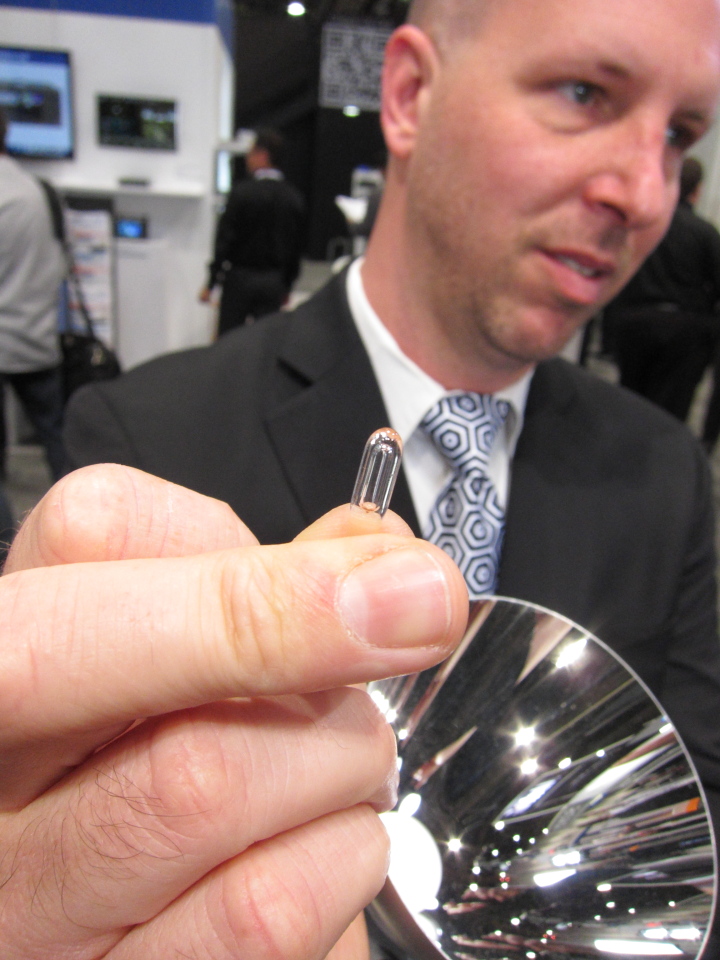
The third picture below shows the actual bulb.  Yes, that's it.  The bulb life is about 10,000 hours with no color change or output variation.  Total bulb life is about 30,000 hours.  The bulbs normally come in a large heat sink assembly and when the bulb dies, the whole assembly gets replaced by a service technician.


BrighShot is another small innovative company making RGB LED lights.  These fixtures come with a handheld controller that allows you to program the lights for various flashes.  For instance, these lights are used on most of the police dramas on television today.  Anytime you see patrol car lights on camera, but not the actual car, it's probably this light generating the gag.  The company owner showed us demos of flashing lights from an ambulance, police car (LA, NY, Chicago...yes, they are different), fire truck, lightning, and fire/flickering candle light.  The most annoying one was the flashing strobe (AUGH! MAKE IT STOP!).  Like the Arri light, dialing in a particular RGB color was easy with the controller in hand.


Ikan was showing off their wide array of LED lights.  Like Arri, they offer a number of lights with digitally controlled color temperature and dimming.  Unlike most vendors, they offer an LED strip light, as shown in the third photo below. This is perfect when you need to emulate a fluorescent fixture or you want an awesome back rim light.  Strip lights are used in fashion and portrait photography all the time, so it's good to know that someone is finally offering a solution for video.  As you might notice in the photos, the prices are well within the range of most budgets.  The representative explained that they have a no hassle warranty policy, which is good news to us.


Another small innovative company is Nila.  Currently they are best known for their "Boxer" series of LED lights.  The latest model has controls similar to the Ikan models.  One of their new innovations is the holographic lens, as shown in the third picture.  It's easy to mistake the cover as a typical diffuser, but this cover is actually a lens that controls the spot/flood beam width.  Just like the lens set that comes with a typical HMI Fresnel, you can exchange the holographic lenses in the field for various beam widths.

Also new this year is the idea of a "remote phosphor."  White LEDs are actually a very blue, ultraviolet emitting LED that excites a phosphor coating.  If you want a "daylight" LED you use a phosphor that emits less red/orange when excited by blue/UV light.  When you want a "tungsten" LED you use a phosphor that emits a lot of red/orange.  The idea here is that they move the phosphor coating normally on the LED itself to the yellow panel you see the representative installing.  Since this panel is user interchangeable, you can create whatever color temperature you want by installing a different "remote phosphor." 

Because the LEDs output very bright ultraviolet light they can damage your eyes, so the fixture has an automatic shut off switch that won't allow the LEDs to turn on while the remote phosphor panel isn't installed.  It gives new meaning to the old phrase, "don't look into the light!"


Brothers, Brothers, and Sons has a unique product in the sense that they have replaced the backing on a source four with an LED (product name: "Force V") and claim equivalent output to a 575W tungsten fixture at much lower power.  The Force-V light is flicker free (yeah!  over crank time!) and you can change the bulb from 3200K to 5600K in about two minutes in the field.  The optics are standard source four optics, but BB&S is working on their own.  So all source four cucalorus patterns should be compatible.  The rep showed me a demo and sure enough, nice even light pattern on the far wall.  Surely this will make a great replacement for the hand burning tungsten models.  You can see the rep placing his hands on the fixture when it's been on for a while.

BB&S also offers "LEDonardo" PAR cans as well as a remote phosphor "Area 48" fixture nearly identical to Nila.


Martin and I talked after the first day of walking through the show floor.  The problem with all these new lighting fixtures and technology is mainly a matter of gaining a solid reputation in the market.  People call up the shop and specifically ask for HMI lights, when the Plasma or LED equivalents might do just as well, if not better...AND with fewer hassles as far as power outlets and set safety are concerned.  We really want to get some of these fixtures into the shop and see how they perform in the real world, so hopefully you'll be reading about the reality of plasma and remote phosphor this summer.

Technology can be confusing, so please do call us if you have questions.  We're here to make sure you have a successful production and you buy/rent the right technology for your specific needs.